Wednesday, July 16, 2025

How to Nurture Prospects Through the B2B Lead Generation Funnel

 In the current B2B systems, preventing the failure of potential new business isn’t optional—it’s mandatory. Businesses spend a significant amount of money on marketing, but without advances, many valuable leads slip away. Raising conversion rates and enhancing customer relationships can be achieved by efficiently managing the b2b lead generation funnel.

Understanding the B2B Lead Generation Funnel

Stages of the Funnel

As we move down the funnel, it collects and retains potential buyers. In the middle tier, leads are educated and qualified. Lastly, high-value opportunities convert to customers at the bottom tier.

How Leads Move Through the Funnel

Orders increase while clients retain over time and makes informed contracts. Your focus should revolve around providing value on every step.

Building an Effective Lead Nurture Program

Defining Buyer Personas

Take note that outlines positioning has shift but who. Understand audience makes drafting and adjusting easier while ensuring content relevant and relatable.

Crafting Valuable Content

Nurturing through lead nurture program, at its core, is an educational endeavor, pushing sales agendas too soon erodes trust.

Educational Resources

Blog posts, infographics, and live webinars equip prospects with fresh knowledge while positioning your firm as a credible advisor.

Case Studies and Whitepapers

Rich, data-driven narratives illustrate concrete results, giving decision-makers the proof they require before committing resources.

Timing and Consistency

Regular, unobtrusive follow-up keeps your name in prospects minds without feeling pushy. Think of each outreach as a friendly nudge rather than a hard sell.

Leveraging Account-Based Marketing (ABM)

Targeting High-Value Accounts

Account Based Marketing directs marketing and sales effort toward a small number of high-potential accounts, making every dollar and hour spent count.

Aligning Sales and Marketing Teams

Cross-departmental planning ensures that tone, timing, and content stay in sync, giving prospects a smooth, unified experience.

Engaging Prospects at Each Stage
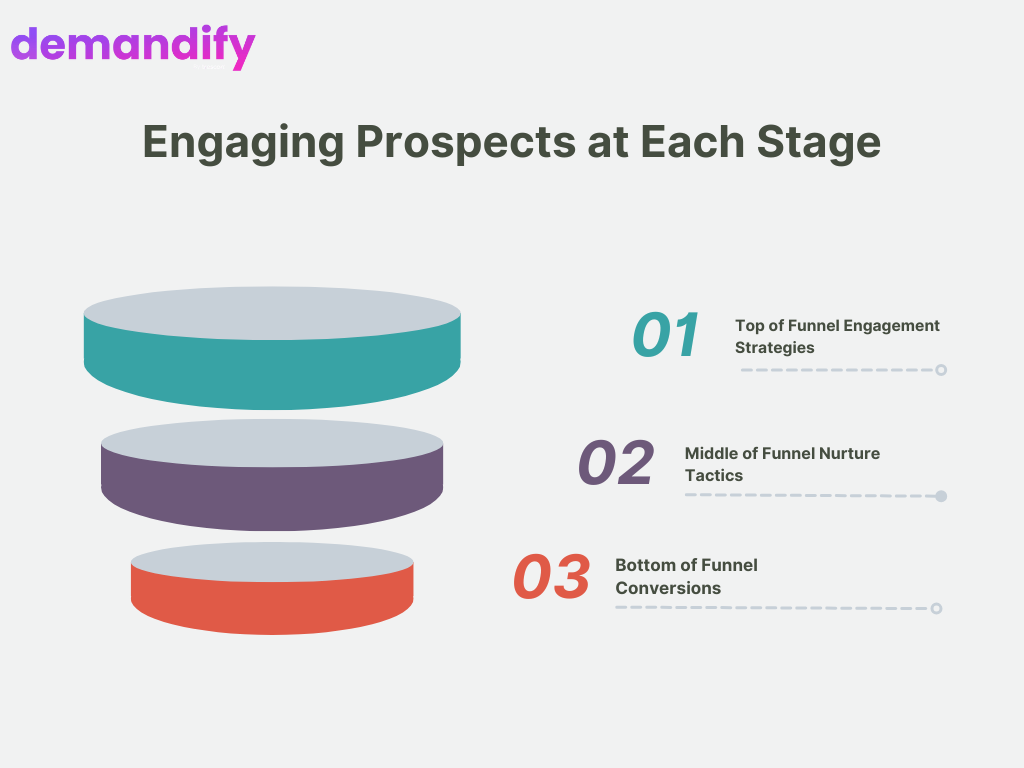
Top of Funnel Engagement Strategies

Kick things off with helpful articles, videos, and social posts that spark curiosity and establish early trust.

Middle of Funnel Nurture Tactics

Now the nurture engine roars: drip emails, detailed eBooks, and quizzes keep the conversation warm and gather fresh intel.

Bottom of Funnel Conversions

When prospects near a decision, offer live demos, clear ROI tools, or custom quotes that answer final objections and seal the deal.

Measuring and Optimizing Nurture Campaigns

Key Metrics to Track

Keep an eye on opens, click-throughs, lead scores, and pipeline speed; these metrics reveal which elements lift or lag.

Continuous Improvement

Regularly analyze results, experiment with small changes, and repeat; a strong nurture program evolves alongside your audience.

Conclusion

Patience, effort, and communication are required to lead your prospects through the b2b lead generation funnel. At some point, if you produce content that matches each stage, apply specific techniques like Account Based Marketing, and create an effective lead nurture strategy, you will undoubtedly earn trust for your organization and, over time, it will become easier to convert prospects.

Read Other Information:

How B2B Appointment Setting Drives Sales Growth in Competitive Markets

How Lead Scoring Improves Your Lead Nurture Program Performance

How to Create Ideal Customer Profiles for Effective ABM Lead Generation

Why Transparent Call Back Consent Policies Build Long-Term Loyalty


Tuesday, July 15, 2025

Why Transparent Call Back Consent Policies Build Long Term Loyalty

 In the modern, digitally driven economy, trust is a necessary component of any lasting customer relationship. Within the scope of customer engagement, especially in data-sensitive industries, call-back consent policies are proving to be very important in trust construction and maintenance. By defining the ways and occasions organizations would reach out to prospects or clients, businesses can create trust and respect, which ultimately leads to long-term loyalty.

The Importance of Call-Back Consent

Call-back consent is more than a checkbox. It is a customer's proactive engagement. Call-back policies, when communicated clearly, demonstrate that customer privacy is respected, especially when permission is actively obtained prior to calling. From a marketing perspective, placing restrictions on what can be done and what can’t during interactions minimizes the chances of uninvited engagement, allowing a business to build trust right from the first touch point.

Customers would be willing to engage with a business that seems to value gaining consent and has laid out in details what it intends to do. Intent data from industry also indicates that customer satisfaction and retention are on the rise as customers feel they are in control of their dealings with the business.

Enhancing Customer Experience Through Transparency

https://demandifymedia.com/enhancing-customer-experience-with-clear-call-back-consent/

Maintaining a transparent call-back consent policy ensures customers are not caught off guard by unsolicited communications. Rather, they wait for the exact time they scheduled to be contacted. This minimizes frustration and increases the likelihood of favorable interactions. Also, in terms of intent data, knowing when a prospective client is ready to be contacted—and obtaining permission beforehand—can improve experience and enhance conversion rates significantly.

In addition, the need for communication policies bound by transparency becomes critical in b2b demand generation. This is because B2B decision-makers are time-strapped. With clear consent policies in place, organizations can position themselves as trustworthy partners who value collaboration and prioritize time efficiency.

Building Loyalty and Trust for the Long Term

Long-term loyalty stems from regular, respectful patron engagements. Transparency concerning honoring preferences and data handling boosts the likelihood of customers remaining loyal. Implementing call-back consent policies offer businesses a means of market differentiation and enables them to comply with regulations.

Embedding these policies within the daily functions of the business shows customers the organization respects their privacy. This creates a lasting impact on the relationship with customers, including greater referrals while gaining a reputation for integrity—all vital components of sustainable growth.

Conclusion

Implementing transparent call-back consent policies is not only a regulatory bare minimum; it is a tactical approach towards gaining trust and cultivating loyalty. Businesses can forge enduring brand equity by utilizing intent data and focusing marketing strategies aligned with customer demands, thereby refining their b2b demand generation efforts and delivering value to the clients as well as themselves.

Read Other Information:

How to Optimize Every Stage of the Demand Gen Funnel

How B2B Appointment Setting Drives Sales Growth in Competitive Markets

How Lead Scoring Improves Your Lead Nurture Program Performance

How to Create Ideal Customer Profiles for Effective ABM Lead Generation

Monday, July 14, 2025

How to Create Ideal Customer Profiles for Effective ABM Lead Generation

Account-Based Marketing (ABM) is not about targeting any arbitrary account.It focuses on the precision of account targeting. This is where Ideal Customer Profiles (ICPs) come into play. With an ICP, abm lead generation efforts can be concentrated on high-value targets most likely to convert, thus maximizing the campaign’s effectiveness. Such profiles direct your messaging, campaign customization, and ultimately drive better returns on investment (ROI) in B2B lead generation.

What is an Ideal Customer Profile (ICP)?

An Ideal Customer Profile is a portrayal of a company that would gain the most value from your solution. An ICP is not an individual but rather includes:

·         Industry

·         Company size

·         Revenue

·         Technology stack

·         Geographic location

·         Purchase behavior

Unlike buyer personas that focus on individuals, ICPs help ABM teams zero in on companies that fulfill the best-fit client criteria.

Why ICPs are Essential in ABM Lead Generation

With clear targeting, everything else falls into place. Messaging is refined, outreach channels are streamlined, and your team saves time that would otherwise be squandered on poor-fit accounts. ICPs serve as a compass steering your abm intent data and B2B outbound engagement.

Steps to Create a Powerful ICP for ABM

https://demandifymedia.com/abm-or-lead-generation/

1.      Analyze Existing Customers

Start by identifying common characteristics among your top-performing clients. Look into:

·         Industry Verticals

·         Revenue Growth

·         Deal Sizes

·         length of the sales cycle


2.      Involve Cross-Functional Teams

Customer support, marketing, and sales usually have different perceptions of what an ideal account is. Team collaboration leads to a more complete ICP.

3.      Use ABM Intent Data

Intent data indicates which companies are currently researching similar solutions. Integrating ABM intent data during ICP creation allows prioritization of accounts that are already showing intent.

4.      Segment Your ICPs

Not all good-fit accounts are homogeneous. Group them into tiers:

·         Tier 1: High-value, high-likelihood to close

·         Tier 2: Medium-fit, moderate deal size

·         Tier 3: Broader market, lower personalization

This enables more precise messaging and efficient resource allocation.

5.      Validate and Refine Continuously

ABM approaches these strategies in a different way. While campaigns are live, revisit core assumptions and refine your ICPs based on actual use. This helps b2b lead generation remain consistently effective.

Benefits of Building ICPs for B2B Lead Generation

·         Higher Conversion Rates: Targeting more accurately means stronger outcomes.

·         Improved Sales Efficiency: Reduction in time and resources spent on useless cold leads.

·         Better ROI: Greater number of deals closed with a smaller investment of resources.

·         Personalized Campaigns: Compelling communication resonates more when it’s hyper-relevant.

Final Thoughts

Developing Ideal Customer Profiles is not only an element of strategy, it is a critical component of abm lead generation. Businesses can focus on the most important accounts with the use of ABM intent data in combination with a cross-departmental approach. When executed properly, ICPs are effective in optimizing targeted outreach to achieve substantial lead generation outcomes.

Read Other Information:

How Precision Marketing Improves Lead Quality and Conversion

How to Optimize Every Stage of the Demand Gen Funnel

How B2B Appointment Setting Drives Sales Growth in Competitive Markets

How Lead Scoring Improves Your Lead Nurture Program Performance

Thursday, July 10, 2025

Inbound vs. Outbound: Finding the Right Balance in B2B Lead Generation

 Lead generation is crucial for modern businesses looking to grow. However, here’s the challenge: should you let customers find you, or reach out to them directly? The sweet spot between both inbound and outbound efforts is critical in today’s cutthroat environments.

Both approaches are important. When blended strategically, they drive b2b lead generation through every level of the demand gen funnel.

Understanding Inbound Lead Generation

Core Principles of Inbound Marketing

Inbound focuses on engaging prospects with value, be it educational content, SEO, or social media. Think of it as setting a magnet for your ideal audience.

Content Marketing and SEO

Inbound relies heavily on blogs, whitepapers, and videos. By ensuring this content is optimized, you improve the chances of prospective clients finding you.

Role of the Demand Gen Funnel in Inbound

Inbound also nurtures engagement generated at the awareness stage of the demand gen funnel. As leads progress through the funnel, targeted content is increasingly provided to nurture readiness for sales.

Key Benefits of Inbound in B2B Spaces

Inbound offers sustainable, organic growth. In addition, it builds authority and trust, both crucial in any B2B relationship.

Outbound Lead Generation Explained

Fundamentals of Outbound Sales & Marketing

This is a reversal of the typical procedure. Rather than waiting for contacts, you engage prospects through cold calls, emails, or paid media.

Cold Outreach & Paid Ads

Paid media and cold outreach focus on specific decision-makers. This increases response rates, particularly for brand new markets.

Account-Based Marketing (ABM) Tactics

Outbound complements ABM perfectly, where tailored outreach is directed at high-value accounts.

Why Outbound Still Works in B2B

Outbound is still essential in targeting niche industries or accounts who are not actively seeking solutions. It accelerates prospects when inbound is slow.

Comparing Inbound and Outbound: Strengths & Weaknesses


Lead Quality and Intent

Contacts are higher quality inbound as they come through on their own. Outbound provides leads that otherwise would not have been captured.

Speed to Results

Inbound requires time to establish momentum while outbound generates faster results.

Cost Considerations

Lower ongoing costs with inbound, but higher upfront due to content creation. Outbound is immediate but can incur high costs from paid advertisements.

Long-Term vs. Short-Term Gains

The inbound strategy targets the long term. The outbound approach wins quicker results. Both together provide immediate and sustained growth.

How to Find the Right Balance for Your Business

Assessing Your Market & Buyer Behavior

Inbound strategies are effective when your audience is engaged in researching solutions. For some industries, often less digitally inclined, outbound strategies are more effective.

Aligning with the Demand Gen Funnel

Nurture the top of the funnel inbound with content and outbound at the consideration and decision phases.

Using Content Syndication for Hybrid Lead Generation

Through content syndication, both strategies can be integrated—content can be shared through third-party networks to stimulate inbound interest while outbound follow-through is maintained.

Actionable Tips for Integrating Inbound and Outbound


Aligning Sales and Marketing Teams

In cases where marketing and sales work together, lead generation becomes cohesive for all parties. All focus turns to quality instead of quantity.

Leveraging Data and Analytics

Engagement and conversion rates tell a lot about the tactics used. Take advantage of these insights.

Creating a Feedback Loop Between Channels

Incorporate outbound conversations into content and vice versa. Blog or webinar topics can arise from genuine objections encountered in reality.

Measuring Success in Balanced Lead Generation

Key Metrics to Track

Evaluate inbound and outbound efforts on lead quality, pipeline velocity, conversion rates, and customer acquisition costs.

Refining Strategies Over Time

Make sure to evaluate your results from time to time. What works best for you today may not work tomorrow as the market changes.

Common Mistakes to Avoid When Balancing Inbound and Outbound

  •          Put too much focus on one tactic
  •          Neglect message coherence across multiple channels
  •          Disregard metrics-controlled systems and response loops
  •          Forget the do-not-care stage: the middle and bottom of the demand generation funnel.

Conclusion

For b2b lead generation, it’s not inbound or outbound. Rather, it is both simultaneously. With a proper balance, your brand will be able to grab interest, nurture leads, and drive sales easily. Whether through inbound demand gen funnel strategies or outbound campaigns using b2b content syndication, the objective is the same – connections that are meaningful enough to convert.

Read Other Information:

How Intent Data Providers Support Real-Time Personalization in Marketing

How Precision Marketing Improves Lead Quality and Conversion

How to Optimize Every Stage of the Demand Gen Funnel

How B2B Appointment Setting Drives Sales Growth in Competitive Markets

Wednesday, July 9, 2025

How B2B Appointment Setting Drives Sales Growth in Competitive Markets

The competitive nature of businesses today means that there is constant and relentless competition. Companies are always looking for new ways to get an advantage over others, especially when it comes to gaining new clients and expanding their share in the market. One such approach that stands out is B2B appointment setting. If done properly, this process can enable businesses to grow sales significantly, even in heavily saturated markets.

Understanding B2B Appointment Setting

In B2B appointment setting, there is a dedicated team for identifying prospective business clients, qualifying them, and booking meetings with sales representatives. The goal of this process is that sales teams only focus their efforts on engaging encounters with qualified interested leads instead of placing cold calls or combing through contacts. Not only does this approach save time, but it also increases the efficiency and success rate of closing deals.

The Link Between Appointment Setting and Sales Growth

B2B appointment setting works best when there are effort-saving methods to manage a sales funnel. Organizations can streamline their lead nurturance processes by using it, which allows them to:

  • Shorten sales cycles: During a nurturance conversation, sales representatives will only engage with prospects whose interest has already been established or who meet the ideal customer profile.
  • Increase conversion rates: Conversion rates are determined by the number of meaningful conversations held about the total number of conversations. Pre-booked conversations or appointments will increase the likelihood of meaningful dialogues.
  • Optimize resource allocation: Behind every high-priced prospect is a mountain of work. When a sales team strategizes their outreach and centers intent data on high-value prospects, their efforts become more productive and, in return, yield a better ROI.

Companies with robust appointment-setting processes tend to outperform their competitors, especially when advanced technologies and data-driven insights work in synergy. Research indicates that businesses with streamlined processes witness remarkable improvements in their sales performance.

Leveraging ABM Lead Generation for lead generation

In today’s world, B2B appointment setting goes beyond dialing. Sophisticated frameworks such as ABM lead generation, where marketing and sales departments collaborate to design targeted campaigns for high-value accounts, are in use. As such, targeted executives become the aim of the outreach, making it hyper-relevant and thus increasing the odds of securing appointments with decision makers.

Another important element is intent data. By monitoring a prospect’s online activity, including website visits, content interaction, and even search queries, appointment setters can identify leads who are most ready to buy. This enables timely and relevant engagement, which further strengthens the appointment-setting process.

Best Practices for Success

In addition to the impact of appointment setting within the context of competing businesses, the following additional strategies can be adopted:

  • Align sales and marketing: Collaboration between both departments is critical as they need to develop the ideal customer profile and also provide feedback to one another.
  • Invest in training: Ensure appointment setters understand how to effectively engage prospects at all levels.
  • Utilize technology: Automation, CRM software, and performance metrics tools are invaluable for tracking data and improving business processes.
  • Personalize outreach: Each message should specifically target identified prospects and their core challenges.

Conclusion

In a landscape where every opportunity matters, B2B appointment setting stands out as a crucial facilitator of sales acceleration. Through a combination of precise outreach and effective lead generation, businesses can ensure that their sales teams are connecting with the right prospects during optimal moments. This not only enhances the probability of securing deals but also establishes a robust pipeline to support sustained future growth. Businesses that focus on improving their appointment-setting processes are better positioned to compete and succeed in highly turbulent markets.

Read Other Information:

How Sales Teams Can Leverage Intent Data Banks for Smarter Prospecting

How Intent Data Providers Support Real-Time Personalization in Marketing

How Precision Marketing Improves Lead Quality and Conversion

How to Optimize Every Stage of the Demand Gen Funnel

Tuesday, July 8, 2025

How to Optimize Every Stage of the Demand Gen Funnel

Having trouble transforming potential leads into active and loyal customers? You are not alone. A lot of businesses focus their efforts on lead generation without optimizing each stage of the demand gen funnel, thus losing valuable prospects. Optimizing the funnel means ensuring your brand interacts with the right people, conveys the appropriate message, and engages at the precise moment. Adopting this strategy improves the quality of leads and converts more sales.

Understanding the Demand Gen Funnel Stages

Awareness Stage

At this initial stage, your objective centers on making your audience aware of your services and solutions. Use SEO, social media, display ads, and building your brand visibility. The groundwork for everything that happens later relies on proper awareness.

Consideration Stage

Here, prospects are analyzing different options and competing solutions. Informative content like eBooks, webinars, product comparisons, and other trust-building activities help guide towards decision-making.

Conversion Stage

This is where the leads become customers. Forms, CTAs, and user journeys should flow without friction. Convert with seamless optimization, and analyze what works and where improvements are necessary for continuous refinement.

https://demandifymedia.com/creating-a-demand-gen-engine-from-tofu-to-bofu-for-full-funnel-success/

Strategies to Optimize the Awareness Stage

Leverage Content Marketing & SEO

Using relevant keywords in industry specific blogs, how-to guides, and even publishing reports positions you in a place where prospects are actively searching for solutions. Establishing thought leadership is crucial and builds brand credibility right from the start.

Expand Reach with Paid Media

With paid media such as sponsored content, social ads, and even paid search, reaching a new audience becomes quite easy. For better results, make sure to target ads based on user intent.

Track Initial Touchpoints

Make use of analytics tools to monitor traffic sources. These channels can be further optimized to raise awareness at a lower cost, maximizing the value of your marketing budget.

Strategies to Optimize the Consideration Stage

https://demandifymedia.com/fuel-your-sales-pipeline-with-our-lead-nurture-program/

Create Value-Driven Lead Magnets

Give your audience enough reasons to provide their contact information. Templates, whitepapers, and even free trials serve as excellent value exchanges.

Implement a Lead Nurture Program

Your lead nurture program is essential at this stage. A sequence of regular emails containing educational content and case studies gradually build trust and keep the brand top of mind, ensuring prospects are familiar and comfortable before making a decision.

Personalize Communication Channels

Follow-up messaging should take into account user actions and where they are in the funnel. Personalized messaging drives better overall engagement and action from prospects.

Strategies to Optimize the Conversion Stage

Remove Friction in the Buyer Journey

Take a close look at your lead forms and website. Audit them closely. Ensuring simple, fast, intuitive processes makes a world of difference and saves time at every step.

Offer Call-Back Consent Options for Personalized Follow-Up

Allow your leads to call-back consent. This enables more tailored follow-up processes that improve the overall experience.

Use A/B Testing for Continuous Improvements

Regular testing of CTAs, landing pages, and email formats is essential. Even small changes can significantly increase conversions.

How to Measure Success at Each Stage

Awareness KPIs

  • Website Traffic
  • Social media reach
  • Impressions and shares

 Consideration KPIs

  •          Lead form submissions
  •          Webinar signups
  •          Email engagement metrics

Conversion KPIs

  •          Sales-qualified leads (SQLs)
  •          Closed deals
  •          Cost per acquisition (CPA)

Common Challenges in Optimizing the Demand Gen Funnel

Misalignment Between Marketing and Sales

When there is a division between collaboration, leads can be lost. Encourage collaboration and common objectives.

Poor Lead Qualification

Not every lead is prepared to purchase. Improve your methods to identify the highest-potential leads to target your resources.

Ineffective Follow-Up Practices

Conversions die with generic, slow follow-up. Tailor your timing and strategies for maximum effectiveness.

Conclusion

Improving the demand gen funnel is not a single undertaking completed once; it is iterative. Improving all stages—awareness, consideration, and conversion—enhances your ability to convert leads into devoted customers. Employ call-back consent and a strong lead nurture strategy to fortify and streamline your funnel. Recall that an optimized funnel will lead to optimized growth.

Read Other Information:

How Marketers Use Intent Data Banks to Personalize Campaigns

How Sales Teams Can Leverage Intent Data Banks for Smarter Prospecting

How Intent Data Providers Support Real-Time Personalization in Marketing

How Precision Marketing Improves Lead Quality and Conversion

Monday, July 7, 2025

How Precision Marketing Improves Lead Quality and Conversion

 In today’s fiercely competitive digital market, fostering quality leads and converting them swiftly drives business success. The era of generic advertising campaigns that moved the sales needle is over, replaced by Precision Marketing, which zeroes in on specific consumer segments most likely to respond. By merging data analytics, behavioral cues, and intent indicators, this approach elevates the standard of leads and boosts conversion rates, giving firms a clearer path to measurable growth.

Targeting the Right Audience with Precision Marketing

With the help of relevant tools at their disposal, Precision Marketing enables businesses to focus their marketing on potential buyers who, at the very least, have shown some interest in their products or services. Marketers can analyze data in real-time to gauge which prospective audience segments are browsing or engaging with relevant materials. This means businesses can now develop campaigns that are tailored towards prospects who are far more likely to convert.

With the ability to analyze website visits, content download, PC time, and  overall search behavior, precision marketing picks out leads that are most likely to make a purchase. This helps sales teams conserve energy and resources on the prospects who matter while greatly reducing efforts on irrelevant audiences.

Strictly Focused on Lead Quality Over Quantity

Improving lead generation requires carefully balancing lead volume with lead quality and maintaining a strong focus on the latter. Rather than seeking widespread conversions, Precision Marketing targets high-intent audiences. This approach guarantees that every marketing dollar is spent on people and accounts that meet the ideal customer profile and have a higher likelihood of advancing through the funnel.

Personalized Engagement That Drives Conversions

Today’s buyers expect some form of personalized communication. Precision Marketing helps businesses develop hyper-personalized messages, campaigns, and experiences that speak directly to the target audience. With the aid of tailored landing pages, targeted advertisement sequences, and bespoke email campaigns, trust and interest can be cultivated with the right prospects resulting in higher conversion rates.

Integrating Account-Based Marketing for Strategic Impact

For implementing Precision Marketing successfully, an effective method is to use Account-Based Marketing. Unlike traditional marketing, ABM targets group and focuses on engaging high-value accounts instead of one person. With the collaboration of the marketing and sales teams of a business, tailored outreach plans can be devised for key decision makers of the targeted corporation. ABM is often supported by Precision Marketing, which furnishes the needed data to identify and target the most promising accounts and design campaigns tailored for them

Supporting the Demand Gen Funnel Across All Stages

The importance of Precision Marketing goes beyond the top of the funnel; it encompasses the entire demand generation funnel. During the awareness stage, educational content piques interest. During consideration, product comparisons and case studies assist in making evaluated decisions. Finally, in the decision stage, the sales team secures the sale. Throughout this process, Precision Marketing guarantees optimal communication with stakeholders.

Driving Measurable Business Outcomes

The objectives of Precision Marketing extend beyond just enhancing the quality of leads; it seeks to improve conversion rates as well. Businesses leveraging this strategy typically enjoy streamlined sales cycles, better marketing ROI (return on investment), and enhanced coordination between sales and marketing functions. This results in improved efficiency within the sales pipeline and accelerates revenue growth.

Conclusion

In the contemporary B2B environment, refining lead generation and boosting conversion rates are essential for enduring growth. With its sophisticated and strategic data utilization, Precision Marketing allows businesses to engage high-intent prospects through customized and relevant communications. Businesses can improve their sales and marketing performance by prioritizing lead quality along with supporting initiatives such as ABM and effectively managing prospects through the demand generation funnel. With precise application, Precision Marketing reshapes the perception of marketing from being general and unstructured to proactive, focused, and outcome-oriented.

Read Other Information:

How B2B Intent Data Can Help Shorten Your Sales Cycle

How to Measure Success in a B2B Content Syndication Campaign

How Marketers Use Intent Data Banks to Personalize Campaigns

How Sales Teams Can Leverage Intent Data Banks for Smarter Prospecting

How Intent Data Providers Support Real-Time Personalization in Marketing

How AI Dialers Are Transforming B2B Outbound Sales in 2026

  Why Modern Sales Teams Need AI Dialers     In today’s competitive B2B environment, outbound sales teams must connect with prospects quickl...